

Kai is fifteen, a sophomore, and would rather be on his phone than reading anything with a spine. So when I set The Mindfulness Journal for Teens on the kitchen table and told him it was his for a month, I did not expect much. I expected it to sit there. I have watched a great many well-meaning books sit exactly there over the years. What actually happened is that he put it in his gym bag, took it to volleyball practice, and came home in week one with a question for me about something he had written down.
I am Grace Nakamura. I spent twenty-eight years as a middle school counselor in public schools, and these days I run a small Saturday morning book circle at the library here in Hilo with six to eight kids between thirteen and eighteen. My method has not changed in a decade. I read a book myself first. Then it goes to Kai with no instructions. Then it goes to the circle, where it gets passed around for a month. I watch two things: whether they finish it, and what they bring up afterward. The Mindfulness Journal for Teens, written by Jennie Marie Battistin, is one of maybe four books in the last three years that survived that process with the older end of my group. What follows is what six months of watching it get used, put down, and picked back up actually looked like.
The Quick Verdict
The rare journal teens actually write in, as long as nobody assigns it to them. Best from about fifteen up, with a real ceiling on how much any book can do.
Amazon Check Today's Price →If your teen has already rolled their eyes at one journal, this is the one to try next
Prompts and practices, not a program to keep up with. The teens in my book circle who kept it were the ones who found it on their own. Leave it on the table, say one sentence, and step back.
Amazon Check Today's Price on Amazon →How I've Used It
My process is the same for every book I look at, and it is deliberately dull. I read it first, in the evenings, over about a week. Then it goes to Kai with no more instruction than tell me what you think. Then it goes to the book circle for a month. It comes back with pencil marks in it, or it does not come back at all because someone quietly kept it. I trust that second outcome more than anything anyone says to my face.
With this one, Kai finished in about five weeks. That is slow for a novel and quick for a journal. He did not read it in order. He flipped to whatever page matched the day he was having, which is how a journal is supposed to work and exactly what I would have done at his age. When I asked him about it, he did not give me a review. He gave me one line: it is not annoying. From a fifteen year old boy, that is a strong rating.
The book circle was more mixed, and the split ran almost entirely along age. The thirteen and fourteen year olds were polite about it, which is the sound of a book not landing. The fifteen and up group asked whether they could keep their copies. Two of them asked where they could get another one for a friend, and one of those two asked me quietly, after everyone else had gone, whether it was all right that he had written the same kind of thing four times in a row. It is. That is what a journal is for.

What the Book Actually Is
A paperback, 150 pages, 5.83 by 8.27 inches, 9.3 ounces. It slides into a backpack side pocket, and more importantly it does not look like a school workbook, which matters more to this age group than adults usually admit. Callisto Teens published it in December 2019 for readers 13 to 18, roughly grades 7 through 9. It has been in print long enough that a lot of the reviews you will find are from parents who bought it during a hard year, and I think that is worth knowing before you read them.
The structure is what the title promises: prompts and practices. Jennie Marie Battistin writes short and direct, and she does not use the soft-focus language that makes a teenager close a book and never open it again. Nothing in it lectures. Nothing in it assumes the reader is in crisis, which is the thing that quietly ruins most mindfulness material for this age group. A fifteen year old can open it on an ordinary Tuesday, write three sentences, shut it, and go do something else without having declared anything about himself. That low stakes entry point is the whole reason it gets used.
It is not the same tool as a gratitude journal, and if you are choosing between the two, that is the fork in the road. A gratitude journal asks a kid to find things to be thankful for. This one asks a kid to notice what is actually going on inside him, which is a harder and less comfortable ask, and the one that tends to pay off later. Some kids need the gratitude version first. Some will find it saccharine and shut down. You know your kid better than I do.
What it is not, as far as any of us could tell, is a system. The kids in my circle who wanted a scoreboard, something to complete and check off, did not find their traction here and drifted within two weeks. Kai did not want a scoreboard. Neither did the older ones. If your teen is the type who finishes a workbook because finishing is satisfying, this may not be the right shape for him.
What Six Months Actually Changed
I want to be careful with this section, because it is where most writing about this kind of book goes wrong. A journal does not fix anything. It does not raise a grade. It does not make a kid calm on the morning of a state test. It does not repair a relationship with a parent. Anyone who tells you a 150-page paperback will do those things is selling you something and does not care whether it works. What I can report is smaller, specific, and honestly a little boring.
Kai started naming things out loud that he used to just carry around. Not often. Maybe once a week, in the car, in passing. He would say he was wound up before a match instead of simply being wound up before a match. Same feeling, different sentence. That is what a decent prompt does. It gives a fifteen year old the vocabulary for a feeling before the feeling gets expensive. The prompt did not change him. It handed him a word he did not have at thirteen.
In the circle, the shift was easier to see because I have known these kids for years. The ones who used it started answering questions about themselves with more detail. Less fine. More I do not know, kind of tired and kind of relieved. That is a real change and it is not a dramatic one. Six months in, two of the eight still carry it in their bags. Two is not a lot. It is also not nothing, and both of those two picked it up without an adult standing over them.
The honest summary is that the book helped the kids who were already half a step toward wanting it. It did not create that half step. If you are looking for the thing that creates it, this is not that thing, and I am not sure a book ever is. Most of the time it is a person who leaves a door open and does not stand in it.
Where It Stalls
Every kid who did not take to it had one thing in common. They were told to. A parent or a teacher handed it over with an assignment attached, and the journal turned into homework on contact. I watched this happen with two of my circle kids after a well-meaning adult suggested a page a night. Both stopped inside a week. The book did not fail. The framing failed, and it failed in a way that is very easy to avoid.
The other limit is the low end of the age range. The publisher says 13 to 18. I would push that up. At thirteen, several of the prompts landed as abstract. The kids could read the words but did not have enough life behind them to have anything to say back, and a prompt you cannot answer teaches you that journaling is not for you. Fourteen is closer to a real floor. Fifteen is where it starts to hit, and sixteen and seventeen is where it does its best work.
It is also a paperback that lives in a gym bag in a humid climate, and after six months it looks like it. Kai's copy has a bent corner and a crease across the front cover. A kid who likes things to stay nice will be irritated by that. A kid who does not care will never notice. Neither reaction tells you anything about whether the book works.
One more thing that is not a flaw in the book but is a real tradeoff. There is no adult section. No guidance for the parent or the teacher on how to talk about what a kid writes, or how not to. If you are the kind of adult who wants a script, you will have to build it yourself, and the safest version of that script is very short. Ask what they thought about. Do not ask what they wrote.
How to Hand It Over Without Ruining It
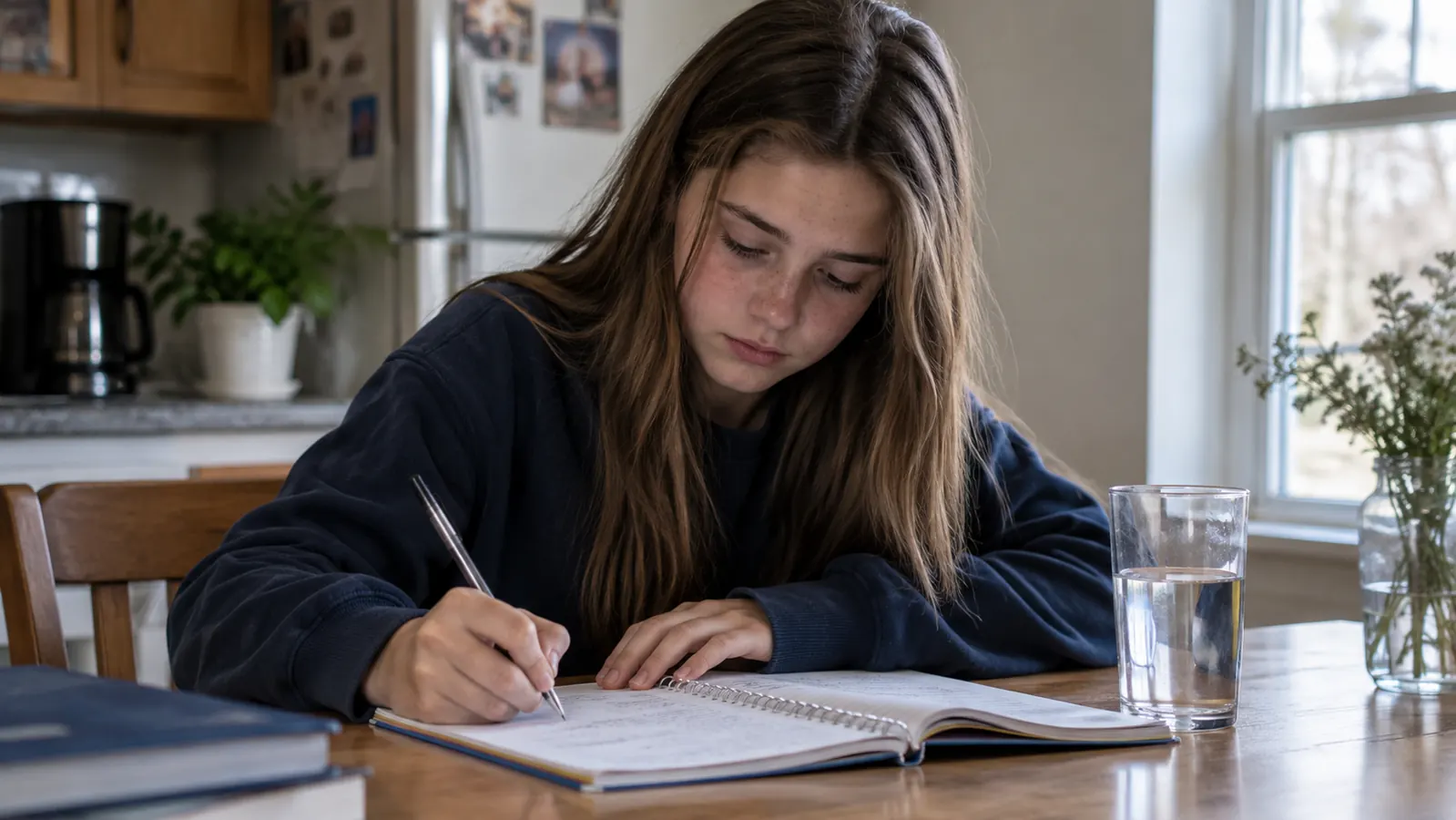
Do not assign it. Do not ask for a page a night. Do not read it after they are finished with it, and do not ask to. If you want a teenager to use this, leave it somewhere visible, say one sentence about what it is, and then go be busy. That is the entire method, and every failure I have watched in six months came from adding to it.
Let them skip. Kai has whole stretches of his copy that are untouched. Some of the circle kids started at the back and worked forward. A journal used out of order is a journal that is working. A journal read front to back because someone said to is a book report with feelings in it.
And when they do bring something up, resist the urge to make it a lesson. The most useful sentence I have found in thirty years of this work is some version of that sounds like it was a lot. It is not a technique. It is just the thing that keeps the door open for the next time.
Two of the eight kids in my book circle are still carrying it six months later. Both of them picked it up without an adult standing over them.
What I Liked
- Written for 13 to 18 without talking down, and the older teens in my circle were the ones who kept it
- Prompts and practices rather than a program, so a kid can open it on a bad Tuesday, write three lines, and close it
- 150 pages at 5.83 by 8.27 inches and 9.3 ounces, so it actually travels in a backpack
- Assumes nothing about the reader, which means a kid in a good season can still use it
Where It Falls Short
- Abstract at thirteen and fourteen, closer to a real fit at fifteen and up
- Kids who want something to complete and check off lose interest inside two weeks
- Paperback corners bend fast in a gym bag
- Turns into homework the moment an adult assigns a page a night
Who This Is For
This is for the fifteen to eighteen year old who has some private weather going on and no clean way to describe it. It is for the kid who would rather write than talk, or who talks fine with friends and goes quiet around adults. It is for the parent who has already tried the direct conversation and watched it go sideways, and who is willing to leave a book on a table instead of asking a question.
It is also, quietly, a good fit for a grandparent or a mentor who wants to give something better than another gift card and does not want to make a speech about it. And it is a reasonable fit for a teacher or a youth leader who will keep it in a classroom library with no assignment attached. The moment it becomes curriculum, the value drops.
Who Should Skip It
Skip it if your teen is thirteen or fourteen and still finds feelings-talk embarrassing, because an unanswered prompt is worse than no prompt. Skip it if your kid needs a structure with visible progress to stay interested. Skip it if the plan is to use it as a consequence, a summer assignment, or a replacement for actual counseling. And skip it if you want a book that will change a kid in thirty days. Jennie Marie Battistin did not write that book. Nobody has.
A book is a nudge, not a repair. This one nudges well.
150 pages of prompts and practices for ages 13 to 18, and a real chance of actually getting used if you hand it over without instructions. If it sits on the shelf for a month, you have lost nothing but a month.
Amazon Check Today's Price on Amazon →